
About Alberobello

Alberobello, in the region of Puglia in southern Italy, is a strange and picturesque destination which is becoming an important fixture on the travel itineraries of tour operators as well as independent travellers. The small town has been made a UNESCO World Heritage site for its unusual districts of trulli, the characteristic white-washed conical-roofed houses of the area. It makes an interesting day-trip destination or a pleasant base for a few days – especially if you stay in a trullo of your very own.
What is a trullo?
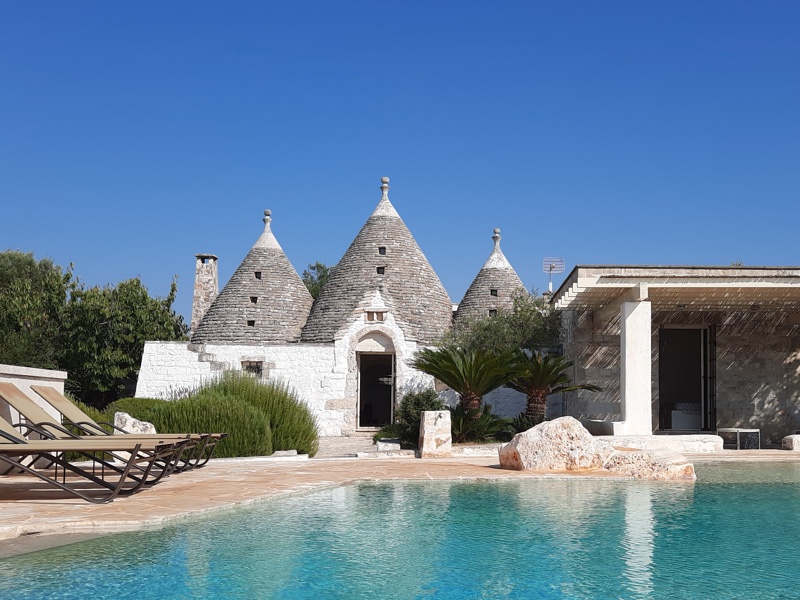
A trullo is a small dwelling built from the local limestone, with dry-stone walls and a characteristic conical roof. It is a traditional and simple type of structure which you’ll see dotted around this part of Puglia, sometimes in its most basic form used as a kind of shed among the olive groves. The story behind Alberobello, once a town of trulli alone, is a typically Italian one: its design was to fiddle taxes and fool the authorities. The local feudal lord, Count Acquaviva, moved his peasant workers here to clear woodland and cultivate the land. To wriggle around laws and taxes, it was important that Alberobello didn’t class as an inhabited settlement. So until 1797, when Alberobello was finally given ‘town’ status, the people had to live in trulli, which could be dismantled in a hurry when necessary.
The buildings are usually square and have very thick stone walls, constructed without mortar. The thickness strengthens the structure and also helps regulate the internal temperature. The roof is actually a dome, as you can see when you enter one of the buildings, but is almost invariably built up on top into a cone shape, topped with a spire. There is generally a central room, with additional living spaces in arched alcoves. Residential trulli are smartly whitewashed, and their roofs are often decorated with fanciful painted symbols supposed to have religious or superstitious significance. The fanciness of the spire decoration was something of a status symbol: it showed the builders’ skill and thus the spending power of the owners. Frequently the houses consist of more than one trullo roof: they are more like trullo complexes crowned with several roof-cones.